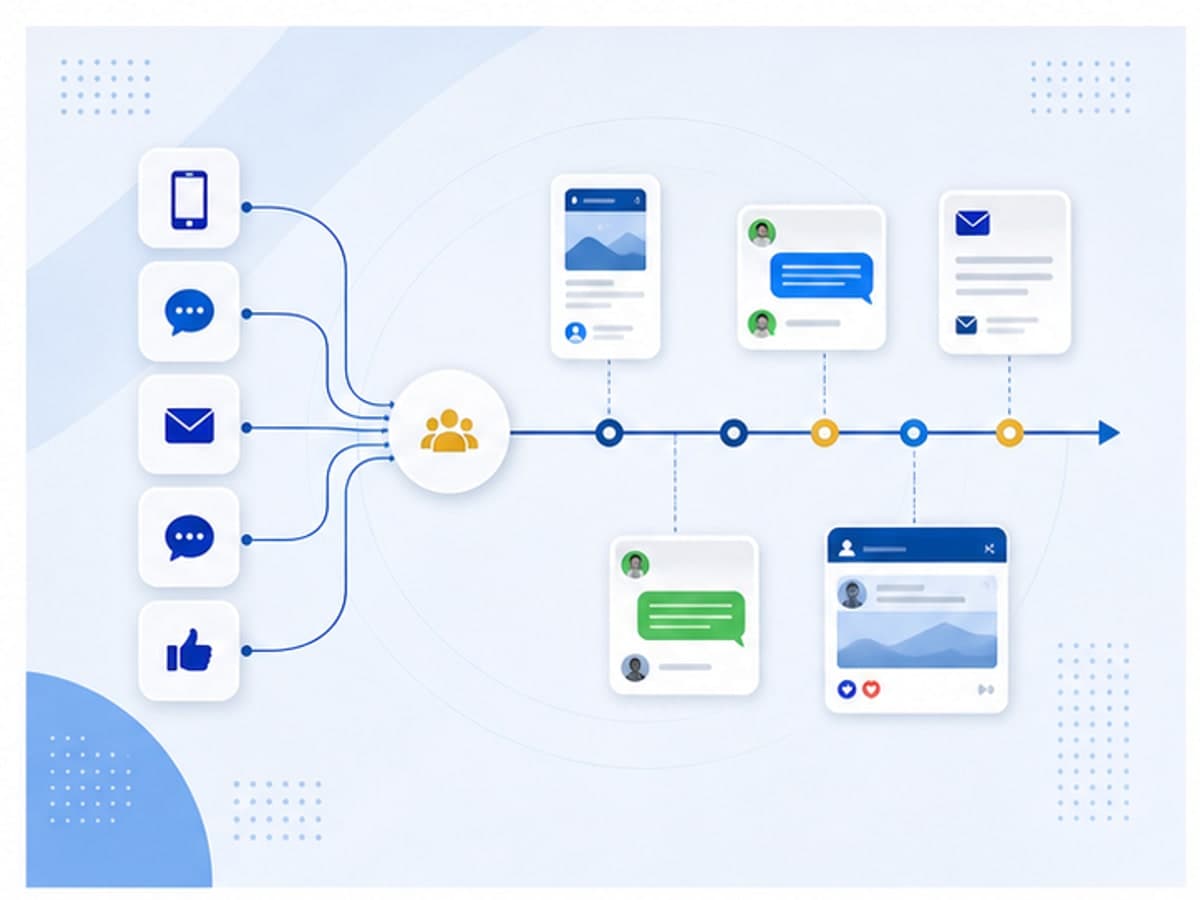
The complete customer service outsourcing process — defining scope and quality, choosing a delivery model, running the vendor evaluation, structuring the contract, and managing knowledge transfer, pilot, and ramp.
Before you talk to any provider
Step 1: Define what you are outsourcing — precisely
"Customer service" is not a scope. List the contact types (order support, billing, technical questions, complaints, returns), the channels (voice, email, chat, social), the hours of coverage, the languages, and the volumes by interval. Providers can only quote accurately against a defined scope, and vague scopes produce the pricing disputes that sour engagements later.
Step 2: Write down what good looks like
Document the service levels you actually need: answer speed, resolution targets, quality standards, and the tone your brand requires. If you cannot describe what a great interaction looks like today, an external team cannot reproduce it. This document becomes the backbone of your RFP, your contract, and your quality program.
Step 3: Choose a delivery model
Decide early whether your program needs onshore agents, near-shore delivery, offshore economics, or a blend routed by contact type. The decision drives cost, provider shortlist, and customer experience — our guide to US-based call center outsourcing covers the tradeoffs in detail.
Selecting the provider

Step 4: Shortlist and RFP
Shortlist three to five providers whose specialization matches your program — industry experience, channel mix, and scale bracket. Issue a structured RFP built from your scope and quality documents so responses are comparable. Ask every provider the same questions and score against the same rubric.
Step 5: Validate beyond the sales team
Talk to references running programs similar to yours. Visit or video-tour the operation. Meet the people who would actually manage your account — not just the sales engineers. Ask how the provider handled their last major service failure; every operator has one, and the honest answer tells you more than any case study.
Step 6: Security and compliance review
Review certifications (SOC 2, PCI DSS, HIPAA where relevant), data handling practices, access controls, and business continuity plans before contract — not after. Confirm where your customer data will live and who can see it.
Step 7: Contract on outcomes
The contract should define service levels with measurement methods, quality audit rights, reporting cadence, data ownership and return, staffing assumptions, change control, and exit terms. Agree now on how disputes over quality get resolved; you will be glad you did.
Launching the program
Step 8: Knowledge transfer
Budget real effort here — it is the single strongest predictor of ramp speed. Provide product training, systems access, escalation paths, tone guidelines, and a living knowledge base. The provider builds the curriculum; your team validates it.
Step 9: Pilot with defined success criteria
Start with a bounded slice of volume and explicit success metrics agreed in advance. A pilot without pass/fail criteria is just a slow launch. Route a genuine mix of contacts, not the easy ones.
Step 10: Ramp, then manage the relationship
Scale volume as quality holds. From day one, run weekly operational reviews and monthly or quarterly business reviews covering quality trends, customer feedback themes, and improvement actions. Outsourcing fails most often not at selection but in month four, when nobody on the client side owns the relationship anymore.
Common mistakes to avoid
- Selecting on price per hour instead of cost per resolved contact and customer outcomes.
- Outsourcing a broken process and expecting the provider to fix what you could not describe.
- Skipping the pilot because the timeline is tight — the timeline gets much tighter when a full launch goes wrong.
- Treating go-live as the finish line when it is the starting line of the management work.
Global Empire Corporation runs this process with clients every month — from scope definition through pilot and ramp. Explore our customer care outsourcing services or read our guide to choosing a BPO partner.
Building the baseline before anything moves
The most common process failure is not choosing the wrong provider; it is being unable to tell afterwards whether the change helped. That happens when no baseline was captured, and it is unrecoverable once the work has moved.
Capture, for at least a full representative cycle: contact volume by channel and by hour, so the provider can staff to the real curve rather than a monthly average; the current handle time and service level, measured the way you intend to keep measuring them; the contact-driver mix, because it determines training length and is the thing most likely to change; current quality and satisfaction using the instrument you will keep using; and unit cost computed fully rather than as wages. Write the definitions down alongside the numbers. Most before-and-after disputes turn out to be definitional rather than factual.
Knowledge transfer, in the order that works
Between selection and launch sits the phase that decides the outcome, and it is consistently underestimated because it looks administrative. The information a tenured agent uses is mostly undocumented: it lives in habit, in the colleague nearby, and in a sense of which exceptions are routinely granted. Whatever is not written down before launch is rediscovered slowly, in front of customers.
A sequence that works: document the top contact drivers with real answers rather than policy summaries; enumerate the exceptions and who may grant them; provision system access early, because security review is the step that most often slips and it blocks everything downstream; run training with real historical contacts rather than invented scenarios; then nest, with new agents handling live contacts under close supervision and a high error rate that is expected. Only then ramp, one queue or channel at a time.
Governance after go-live
Most programs are managed intensively for a quarter and then drift, which is when the quiet problems accumulate. A light but fixed rhythm prevents it. Weekly during ramp and monthly afterwards: review service level and quality against definitions, walk the escalation log for anything that should have been resolvable, and record knowledge gaps as actions with owners. Run calibration sessions where your reviewers and theirs score the same interactions independently and reconcile the difference — this is the single most effective governance habit, because it keeps two organisations sharing one definition of good.
Quarterly, look at the things a monthly review will never surface: contact-driver mix shifting, unit cost trend, whether the knowledge base has kept pace with the product, and whether the scope has grown without being priced. Our SLA guide covers which of these obligations belong in the contract rather than in goodwill.
Frequently asked questions
How long does the customer service outsourcing process take?
From scope definition to a running pilot, a focused program typically takes several weeks to a few months depending on complexity, systems access, and how quickly internal documentation and training material can be produced.
What should an outsourcing RFP include?
Your scope (contact types, channels, hours, languages, volumes), required service levels, security and compliance requirements, reporting expectations, and structured questions on the provider's experience, staffing model, and quality program — all scored on a consistent rubric.
Should we outsource all customer service at once?
Rarely. Start with a bounded slice — one contact type, channel, or coverage window — prove quality in a pilot with defined success criteria, then expand. Phased transitions protect customers from transition risk.
What is the most common reason outsourcing fails?
Neglect after launch. Programs need ongoing quality calibration, feedback loops, and an internal owner. The second most common: selecting on hourly price rather than resolution quality and customer outcomes.
What should we keep in-house?
Strategy, quality standards, escalation authority for high-stakes exceptions, and ownership of the customer relationship data. A good provider executes and improves the operation; the brand keeps deciding what great service means.
Choosing and scoping a partner
Keep reading
The rest of this cluster, for the question you are actually working through.
- How to Choose a BPO Partner: A Practical Buyer’s Checklist
- Call Center RFP Guide: What to Include and How to Score Vendors
- How to Evaluate Customer Service Outsourcing Companies
- Benefits of Outsourcing Call Center Services (and When It's the Wrong Move)
- In-House vs. Outsourced Customer Service: Costs, Pros, and Cons
- Call Center Outsourcing Cost in 2026: A Practical Pricing Guide