
The Human Layer Behind Your AI Support, Done Properly
AI Support Operations
Most support automation projects succeed at the easy half and then stall. The bot handles the repeat questions well, containment looks good in the dashboard, and the contacts it cannot finish arrive at a human who has no context, no authority and a customer who has already explained the problem once.
Global Empire Corporation staffs and runs the human side of an automated support operation: the handoff, the escalation, the transcript review that finds what the bot is getting wrong, and the agents who finish what it starts. You keep your platform and your automation; we make the part around it work.
- Resolution and repeat-contact rate reported alongside containment, never instead of it
- Handoff carries the full conversation, so the customer never explains twice
- Transcript review of what the bot got wrong, weekly, as a written report
- Agents with the authority to finish the contact, not just to apologise for it
- 1.1B+
- Transactions Processed
- 11+
- Contact Centers Worldwide
- 27
- Service in 27+ Languages
- 35.5k+
- Over 35000 Happy Employees
- 10M+
- New Customers Acquired
Containment Is Not the Metric
Containment rate measures how many contacts never reached a human, which is the same number whether the customer was helped or gave up. Plenty of automation programs report improving containment while their repeat-contact rate climbs and their satisfaction falls, because the two are measuring opposite things.
The pair worth watching is resolution and repeat contact. An automated answer that resolves is a win at any containment level; one that deflects is a cost you will pay tomorrow, with a more frustrated customer attached.




















Where humans belong
What the human layer handles
Escalated contacts
Everything the automation could not finish, picked up with the transcript and the account already in front of the agent.
High-stakes conversations
Complaints, billing disputes, cancellations and anything where being wrong is expensive — routed to a person by policy, not by confidence score.
Bot quality review
Sampled transcripts scored for accuracy and appropriateness, producing the list of intents that need fixing.
Coverage the bot cannot give
The conversations that need judgement at 2am, on the channel your customers actually chose.
How the Handoff Is Designed
Automation fails at the seam, so the seam is where the work goes.
Map what the bot should never attempt
Intents where an automated answer is a liability — cancellations, disputes, anything regulated — routed to a human by rule rather than by confidence.
Make the handoff carry context
The agent receives the transcript, the account and what the customer already tried. A handoff that starts the conversation again is worse than no automation.
Staff the escalation, not the average
Escalated contacts are longer and harder than the ones the bot took. Staffing them against pre-automation average handle time is why so many programs feel understaffed after launch.
Review transcripts weekly and fix intents
The human layer sees exactly where the automation misfires. Feeding that list to whoever owns the bot is what turns support operations into product improvement.
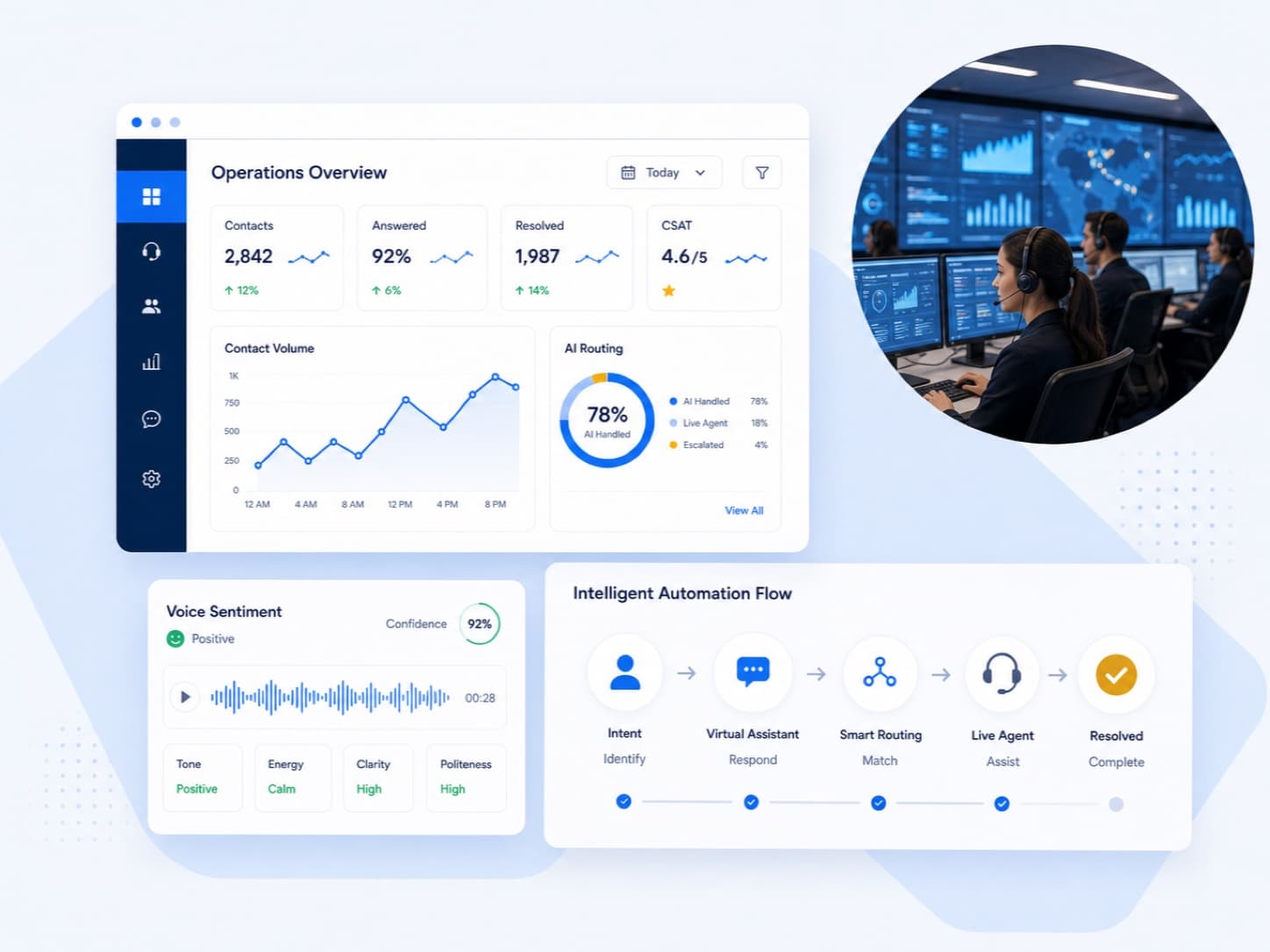
What Automation Actually Changes About Staffing
Automation removes the simple contacts first. What remains is a queue with a higher average difficulty, which means the same volume needs more capable agents, not fewer of them — and that is the opposite of what most business cases assume.
It is also why quality tends to dip a few weeks after a deployment that looked successful on day one. The dashboard shows fewer contacts; the contacts that arrive are all the hard ones; the team was sized on the old mix. Planning for the new mix is the single most useful thing to do before launch.

- Expect handle time to rise after automation — the easy contacts are gone
- Size the human team on the post-automation contact mix, not the old average
- Keep experienced agents on the escalation queue; it is now the hard queue
- Re-baseline quality targets after launch rather than comparing to pre-launch
Related services
Build a complete support program
Frequently asked questions
Do you replace our bot or work with it?
Work with it. You keep your platform and your automation; we staff and run the human operation around them. Where the automation is the problem, we say so with transcripts rather than proposing a rebuild.
How do we know the bot is making things worse?
Repeat-contact rate and post-handoff satisfaction, watched together. A rising containment rate with rising repeat contacts is the signature of deflection rather than resolution, and it is invisible if containment is the only number being reported.
Can agents fix what the bot promised?
Only if they have the authority, which is why the authority matrix comes before the staffing plan. An agent who has to escalate every automation error turns one bad contact into three.
Does this work for voice as well as chat?
Yes, and the handoff matters more on voice: a caller who has spent ninety seconds with an IVR or a voice agent has very little patience left. Warm transfer with context is the difference between recovery and a complaint.
What if we are only starting to automate?
Then this is the right time to talk, because the handoff, the escalation rules and the authority matrix are cheaper to design before launch than to retrofit after one. The most expensive version of this project is the one that automates first and staffs afterwards.
TESTIMONIALS
Our trusted clients
Global Empire has provided essential call center services for over a decade, responding to medical and non-medical emergencies with accuracy and professionalism. Their commitment to quality and continuous learning is clearly reflected in the service they deliver.
I never realized how much overtime we were paying until we started using Global Empire. We were able to eliminate overtime completely while improving how calls are handled. Now our staff can focus on other important tasks that keep our customers happy.
I wasn’t using all the options Global Empire offered until one of their representatives noticed and reached out. Based on their recommendations, we made several changes that saved money and improved response time. Customers now comment on how efficiently our business runs.