Hire Technical Support Agents With the Escalation Line Drawn
Technical Support Agents
Hiring technical support agents starts with a question most teams skip: which problems should the agent solve, and which should they hand on? Draw that line too low and your engineers spend their day on password resets. Draw it too high and customers wait while an agent guesses at a problem they were never trained to fix.
Global Empire Corporation staffs and supervises tier 1 and tier 2 technical support agents against a written escalation matrix. You own the product knowledge, the escalation targets and what counts as resolved; we own recruiting, technical training, the knowledge base discipline and the quality review that keeps tickets moving to the right tier.
- A written escalation matrix by issue type, agreed before launch
- Agents trained on your product in a test environment, not on customers
- Escalations handed on with logs, steps tried and impact captured
- Knowledge base updated from every new issue the team resolves
- 1.1B+
- Transactions Processed
- 11+
- Contact Centers Worldwide
- 27
- Service in 27+ Languages
- 35.5k+
- Over 35000 Happy Employees
- 10M+
- New Customers Acquired
The Escalation Matrix Comes Before the Agent
Tier 1 and tier 2 are not job titles, they are a decision about who owns which problem. The decision lives in an escalation matrix: for each issue type, what the agent tries, what they capture, and when they hand on and to whom. Without it, every agent draws their own line and escalation quality depends on who picked up the ticket.
We write that matrix with you before launch, train agents on it, and review escalations against it every week. A ticket escalated with the logs, steps tried and customer impact already captured saves your engineers more time than any number of tickets closed fast.


Tiers
The support work these agents are hired for
Tier 1 helpdesk
Access, passwords, how-to questions, known issues and first diagnosis, resolved from the knowledge base in the first contact where possible.
Tier 2 troubleshooting
Configuration, integrations, reproducible bugs and account-level problems that need deeper product knowledge and log access.
Onboarding and setup support
Guiding new customers through installation, setup and first use, where good support decides whether they stay.
Incident and outage cover
Absorbing the contact surge during an incident with agreed messaging, so your engineers can fix the problem instead of answering tickets.
How Technical Support Agents Are Hired and Launched
The sequence that decides whether the support tier reduces engineering load or adds to it.
Write the escalation matrix
For each issue type, the steps an agent tries, the information they capture and the point at which they hand on. This is the document the whole program runs on.
Train in a test environment
Agents learn the product hands-on in a sandbox, working real past tickets, before they are given access to live customers.
Launch tier 1 before tier 2
Most programs start with the highest-volume, best-documented issues, then move up as the knowledge base and the agents mature.
Review escalations every week
Every escalation is checked against the matrix. Wrong escalations become training, and new issue types become knowledge base articles.
Measure the Escalation, Not Just the Resolution
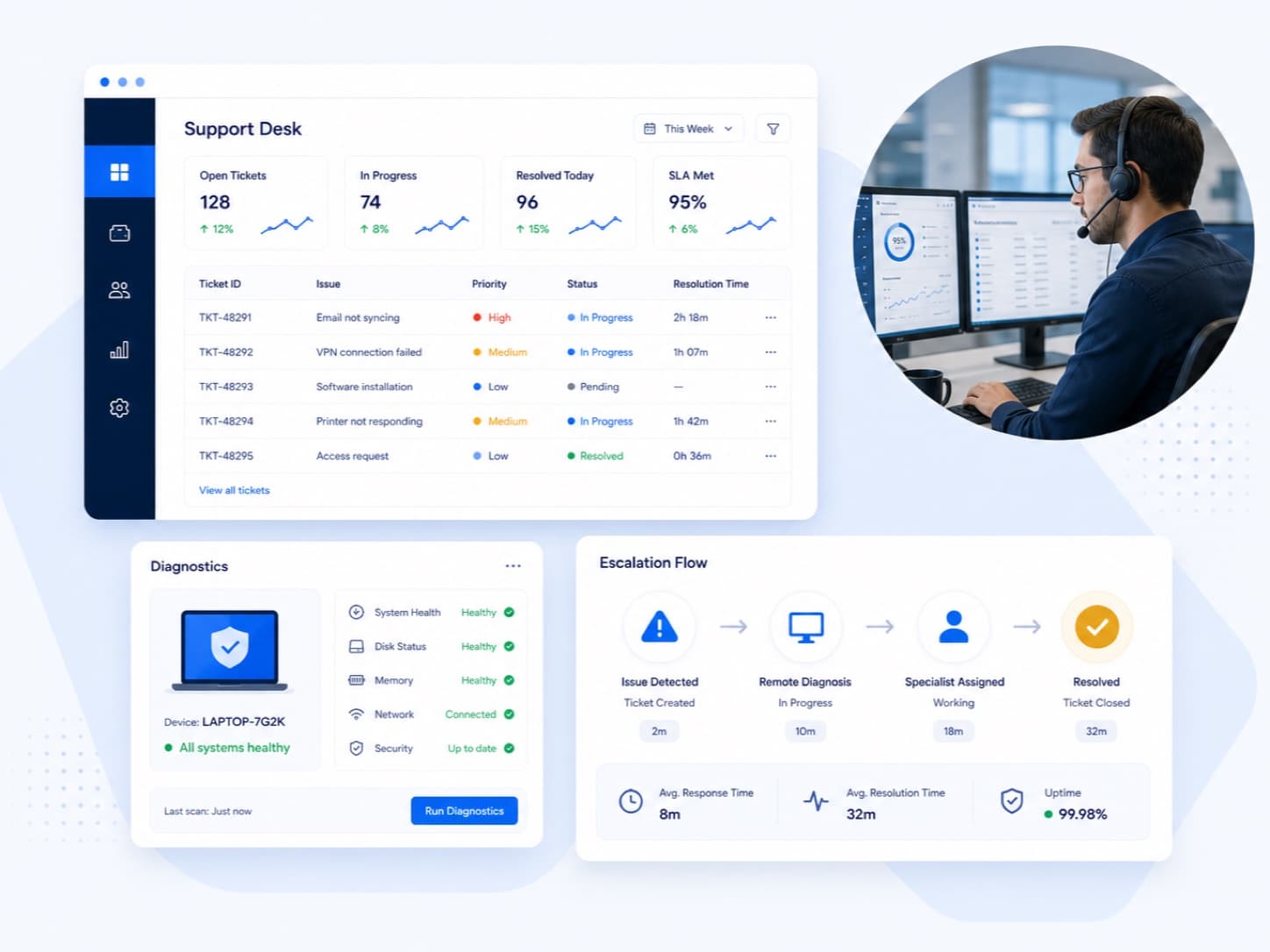
Technical support teams are usually measured on tickets resolved and time to resolve, which quietly rewards the wrong behaviour. An agent measured on resolution rate holds onto tickets they should have escalated, and an agent measured on speed escalates tickets they could have solved.
The better measure looks at escalation quality: was this ticket escalated at the right point, to the right team, with everything the next tier needs? That is what protects your engineers' time, and it is what the weekly review is built around.

- Track escalation accuracy alongside first-contact resolution
- Score every escalation on what was captured before hand-off
- Feed wrong escalations back into training within the week
- Turn every new resolved issue into a knowledge base article
Related services
Build a complete support program
Frequently asked questions
What is the difference between tier 1 and tier 2 support?
Tier 1 resolves common, well-documented issues from the knowledge base and captures everything else properly. Tier 2 handles problems that need deeper product knowledge, configuration access or reproduction. The escalation matrix decides which issues belong where.
What does it cost to hire technical support agents?
The cost is driven by the tier mix, the technical depth required, coverage hours, languages, channels and the tools agents need access to. We scope it against your ticket history and escalation matrix rather than quoting a seat rate.
Can agents work in our ticketing system and tools?
Yes. Agents work in your helpdesk, knowledge base and diagnostic tools with access scoped to their tier, so ticket history and escalations stay in the system your engineers already use.
How long does it take to train technical agents?
It depends on the product's complexity and the quality of your documentation. Well-documented products train faster, which is why the knowledge base and the escalation matrix are usually the first things we work on together.
Can the team cover nights and weekends?
Yes. Coverage is scheduled against when your customers actually raise tickets, and after-hours cover usually starts with tier 1 and a clear escalation path for anything urgent.
TESTIMONIALS
Our trusted clients
We set very challenging service level objectives and insist on those standards being met. At first we were unsure if Global Empire could consistently deliver at that level, but they proved they could. Based on performance and reliability, we know we made the right decision.
Service matters greatly for customer loyalty and experience, and Global Empire provides exactly the professional support required. We’re confident we achieve more value in our contact center because of the strategic partnership and the consistency of their service.
During our recent flood disaster, Global Empire provided messaging services vital to our communications management. Their quick, efficient, and professional response stood out throughout the crisis. In situations like this, service quality is not taken for granted — it’s recognized.