
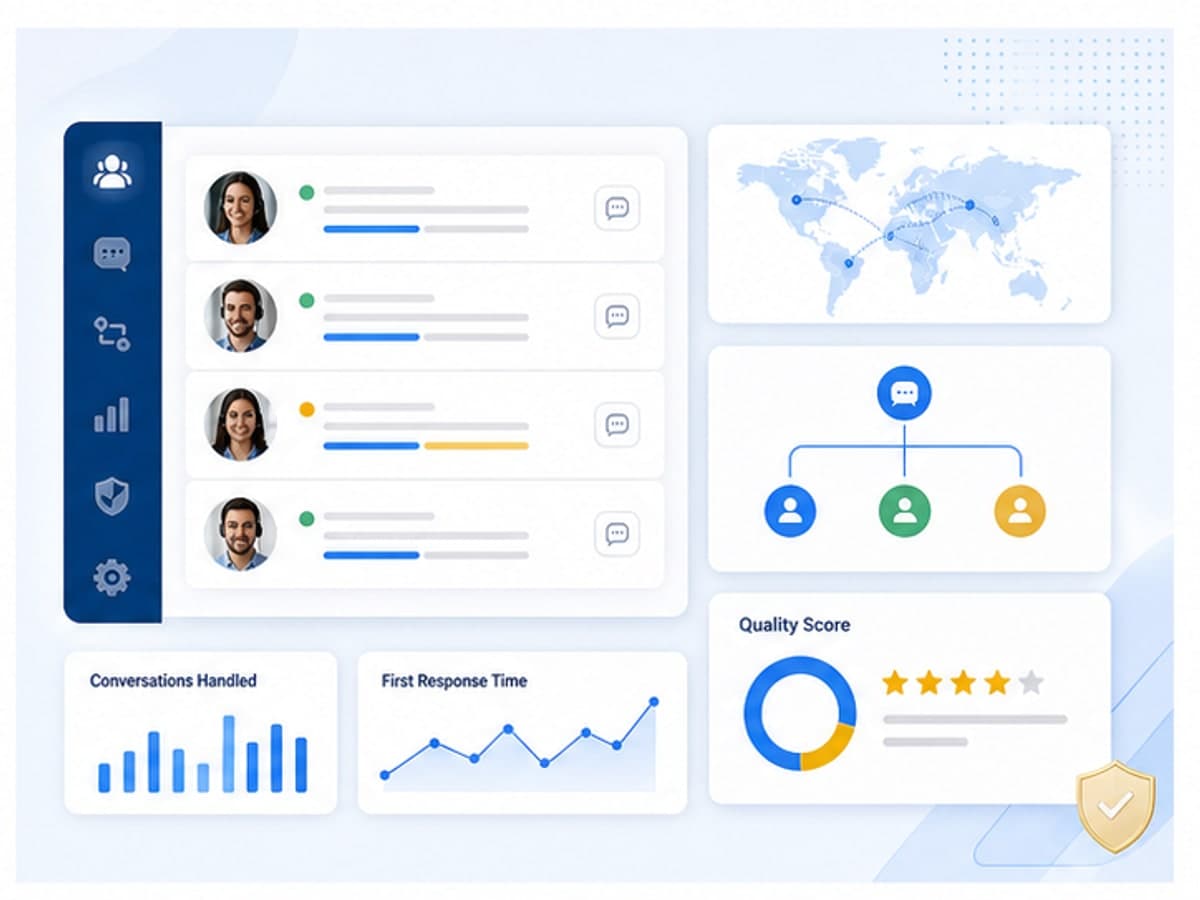
How outsourced live chat teams are staffed and measured, why chat concurrency changes the economics, and what to define before handing your chat channel to a provider.
Why chat is bought differently from voice
Live chat looks like a cheaper version of phone support. It is actually a different operating model, and the difference is concurrency. A phone agent handles one conversation at a time. A chat agent handles several simultaneously — commonly two to four, depending on complexity.
That single fact drives everything else. It changes staffing math, it changes how quality is measured, and it changes how you should read a provider's quote. A chat rate that looks similar to a voice rate is not comparable until you know the concurrency assumption behind it, because an agent handling three conversations costs a third as much per conversation as one handling a single chat.
Concurrency is also the main lever a provider can pull to protect margin. Pushing agents from three concurrent chats to five reduces cost and quietly degrades response times and answer quality. Agree the target concurrency in the contract and report against it. It is the most important number in a chat engagement and the one most often left unspecified.

What outsourced chat teams handle well
- Pre-sales questions on product fit, availability, shipping, and pricing, where a fast answer directly affects conversion
- Order and account support — status, changes, returns, and routine account administration
- Guided troubleshooting where steps can be sent as links, screenshots, or short instructions
- Qualification and routing, capturing intent and passing high-value visitors to sales
- After-hours coverage, where chat is often the most cost-effective way to stay reachable overnight
Chat handles poorly anything requiring extended diagnosis, emotional de-escalation, or complex negotiation. Build a clear path to escalate those conversations to voice rather than letting them run long in a channel that is not suited to them.
Where chat outsourcing creates revenue, not just savings
Support chat is a cost centre. Sales chat is not. A visitor asking a question on a product page is signalling intent, and the response time on that message correlates directly with conversion. Many organizations staff chat purely as deflection and miss this entirely.
If chat sits on commercial pages, measure it commercially: chat-assisted conversion rate, average order value with and without a chat interaction, and revenue per chat. These numbers usually justify better staffing than a pure cost view would allow, and they change the conversation about whether to extend coverage hours.
Metrics that matter
- First response time — the single strongest driver of chat satisfaction, measured in seconds
- Average response time within a conversation — the gaps between replies, where concurrency problems reveal themselves first
- Concurrency — actual chats handled simultaneously, reported against the contracted target
- Resolution rate — conversations closed without escalation or follow-up contact
- Abandonment — visitors who leave the queue before being connected
- Conversion and revenue per chat where chat sits on commercial pages
Watch the gap between first response time and in-conversation response time. A team can hit an aggressive first-response target and still deliver a poor experience if the customer then waits ninety seconds between every subsequent reply. That pattern is the clearest signal that concurrency has been pushed too far.
What to prepare before launch
A response library, not scripts
Chat rewards speed, and pre-approved responses for common questions make speed achievable. They should be building blocks agents adapt, not scripts they paste. Customers recognize a canned response immediately, and it undermines the one advantage chat has over a help article.
Tone and brand guidance
Chat is written, permanent, and easily screenshotted. Define how formal the voice should be, what the team may and may not commit to, how to handle complaints, and when to move a conversation to another channel.
System integration
Agents need order lookup, account access, and customer history inside the chat tool. Alt-tabbing between systems destroys the response times that make chat worth having.
Routing and coverage rules
Decide which pages trigger proactive chat, how sales and support conversations are separated, what happens when queues are full, and what the experience is outside staffed hours. An unanswered chat widget is worse than no widget.
Where the chat window sits changes what it must do
The same chat program serves very different jobs depending on placement, and treating it as one queue produces mediocre results everywhere.
On product and pricing pages the conversation is pre-sale: the visitor is evaluating, questions are about fit and cost, and the measure is conversion. On checkout and payment pages it is rescue: something has gone wrong and the window is short, so response time matters more than anywhere else on the site. Inside a logged-in account area it is support: the customer is identified, history is available, and the expectation is that the agent already knows who they are. In a help centre it is escalation from self-service, meaning the customer has already tried and failed, and opening with a suggestion to read an article is actively insulting.
Route these separately, brief agents differently for each, and hold them to different metrics. A single blended chat queue answers a pricing question and a failed payment with the same posture, and both are served worse for it.
Concurrency is the whole economic argument — and it has a ceiling
Chat is cheaper than voice for one reason: an agent can hold several conversations at once, where voice is strictly one at a time. Every cost model for chat rests on the concurrency assumption, and it is the assumption most often set wrong.
Concurrency is not a dial you turn up freely. Past a certain point each additional conversation degrades all of them — response gaps lengthen, the agent loses the thread, and customers who can see a typing indicator that never resolves start repeating themselves. The workable ceiling depends almost entirely on contact complexity. Simple order-status and availability questions sustain meaningfully higher concurrency than troubleshooting or account disputes, where the agent needs continuous attention on a single thread.
Two practical consequences. First, ask any provider what concurrency their quote assumes and for which contact types — a rate that looks competitive at a high assumed concurrency is not competitive at the concurrency your actual mix supports. Second, monitor response gap within conversations rather than only first response time. Rising in-conversation gaps are the earliest signal that concurrency has been pushed past what the work allows, and they appear well before satisfaction scores move.
Chat staffing does not inherit voice forecasting
Teams that already run voice frequently apply the same workforce planning to chat and are surprised when service levels behave oddly. The models differ in ways that matter.
- Handle time is not a clean unit. A chat may run twenty minutes wall-clock while consuming a few minutes of agent attention, interleaved with two other conversations. Planning against wall-clock duration massively over-staffs; planning against attention time under-staffs during complex periods.
- Abandonment behaves differently. Chat customers frequently leave silently and never signal it, so raw abandonment understates the problem. Track conversations with no customer reply after an agent response as a separate signal.
- Arrival patterns follow site traffic, not phone habits. Chat demand tracks sessions, campaigns and page performance, which means marketing activity moves your staffing requirement with no notice unless the two teams talk.
- Queue tolerance is shorter. A customer will hold on a phone line far longer than they will wait for a first chat response, because chat sets an expectation of immediacy by existing at all.
Proactive chat, and when it backfires
Proactive invitations — triggering a chat based on behaviour rather than waiting to be asked — are where chat generates incremental revenue rather than deflecting cost. They are also the fastest way to make a site feel hostile.
The distinction is whether the trigger reflects a plausible need. An invitation on a checkout page after a payment error is welcome. An invitation three seconds after landing, on every page, repeatedly, is an interruption that trains people to dismiss the widget permanently — including the customers who later need it.
Rules worth setting before launch: trigger on behaviour that suggests difficulty rather than on a timer alone; never re-invite someone who has dismissed an invitation in the same session; suppress invitations when the queue cannot absorb them, because an accepted invitation that then waits is worse than no invitation; and hold proactive and reactive chats to separate metrics, since blending them makes both unreadable.
Transcripts are records
Chat produces a written, retained, searchable record of every customer interaction, which is operationally useful and carries obligations voice does not carry in the same way.
Customers paste things into chat windows that they would never read aloud — card numbers, identifiers, health details — often unprompted and before an agent can intervene. Decide in advance how that is handled: masking or redaction at capture where the platform supports it, explicit agent guidance on requesting that sensitive data be provided another way, and a retention policy that is actually enforced rather than defaulted to indefinite.
Agree who holds the transcripts, where they are stored, how long they are kept, and how a customer request to access or delete their data is executed across both your systems and the provider's. If chat is handled in a different jurisdiction from your customers, transcript storage is a cross-border data question and belongs in the same review as any other.
Chat and automation together
Most mature chat operations run a bot in front of the human team to handle status lookups, common questions, and intent capture, then pass anything else to an agent with the conversation context attached. Handled well, deflection is real and customers do not notice the transition. Handled badly, the bot becomes an obstacle customers try to escape.
Two rules make the difference: always offer a visible route to a human, and never make the customer repeat what they already told the bot. If a provider proposes automation, ask to see the handoff, not the deflection rate.
Frequently asked questions
How many chats can one outsourced agent handle at once?
Commonly two to four concurrent conversations depending on complexity. The figure should be contractually agreed and reported, because raising it is the easiest way for a provider to cut cost at the expense of response quality.
Is outsourced live chat cheaper than phone support?
Per conversation, usually yes, because agents handle several chats simultaneously. Compare quotes on cost per conversation at a stated concurrency rather than on hourly rate alone.
Can outsourced chat agents sell as well as support?
Yes, and chat on commercial pages should be measured on conversion and revenue per chat rather than deflection. Sales-capable chat generally requires different hiring and training from support chat.
Should we use a chatbot alongside outsourced chat agents?
A bot handling status lookups and common questions in front of a human team works well, provided customers always have a visible route to an agent and never have to repeat information already given to the bot.
What happens to chat outside staffed hours?
Define this before launch. Options include hiding the widget, switching to a form or ticket capture, or extending coverage through a provider delivery location in another time zone. An unanswered live widget damages trust.
By service line
Keep reading
The rest of this cluster, for the question you are actually working through.
- Outsourced Lead Generation: How It Works and When It Pays Off
- Inbound Lead Generation Services: Turning Demand You Already Have into Pipeline
- Outsourced Sales Development: Building Pipeline Without Building a Team
- Telemarketing Outsourcing: A Buyer's Guide
- B2C Telemarketing: How Consumer Outbound Programs Actually Work
- Technical Support Outsourcing: A Complete Guide for 2026
- Email Support Outsourcing: How to Scale Without Losing Quality
- Back Office Outsourcing: What to Transfer and What to Keep
- Multilingual Customer Support: Staffing It Properly, Not Translating It
- B2B Appointment Setting: Filling a Complex Pipeline Without Burning the Brand

Live chat outsourcing
Outsourced Live Chat Services
Trained chat agents on your site 24/7, working in your tools and to your response-time targets.