Which back-office processes transfer well to an external provider, how to document work before moving it, and why accuracy and cycle time matter more than headcount cost.
Back office outsourcing in practice
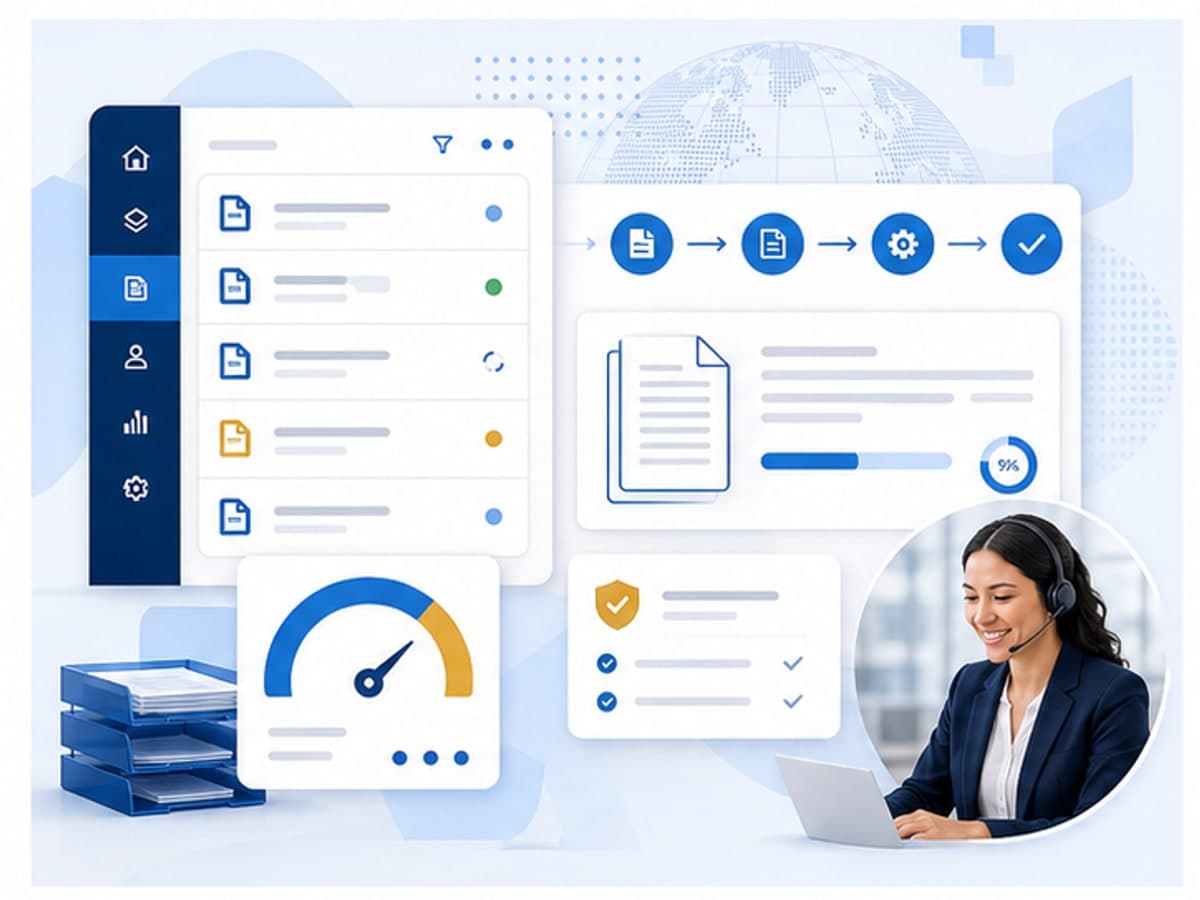
Back office outsourcing transfers the administrative and processing work behind your customer-facing operation: data entry, document processing, order administration, claims handling, invoice and payment processing, records management, reconciliation, and operational reporting.
Unlike contact center work, none of it is visible to your customers — until it fails. A customer never sees order administration, but they see a shipment that never arrived. The invisibility is why back office work is chronically under-resourced internally and why it is often the highest-return function to outsource.
What transfers well
The processes that outsource most successfully share a common shape: high volume, rule-based decisions, documented steps, and objectively verifiable output.
- Data entry and migration — structured input against defined validation rules
- Document processing — classification, extraction, indexing, and filing
- Order administration — entry, changes, exception handling, and status maintenance
- Claims and application processing — intake, completeness checks, routing, and adjudication support
- Invoice and payment processing — matching, coding, exception queues, and reconciliation
- Records and compliance administration — retention, audit trails, and periodic reporting
What to keep in house
Work resists outsourcing when the decision rules are unwritten, when judgment depends on institutional knowledge, or when the process changes faster than it can be documented. If your own team cannot explain how a decision is made without saying "it depends," an external team will not infer it.
Also keep anything where the cost of an error is severe and irreversible, where regulatory accountability cannot be delegated, and where the process is a genuine competitive differentiator rather than necessary overhead. The test is simple: if this process were performed slightly better than your competitors', would customers notice or care? If yes, it probably belongs in house.

Documentation is the whole project
The most common reason back office transitions fail is that the process was never written down. Work that lives in the heads of long-tenured staff cannot move; it can only be rebuilt from observation, and it will be rebuilt incompletely.
Before transferring anything, document the trigger that starts the process, each step and the system it happens in, the decision rules including every exception, what a correct output looks like, how errors are detected and corrected, what the volumes and timing look like across a full cycle, and which downstream processes depend on the output.
This documentation work has value regardless of whether you outsource. Most organizations discover redundant steps, undocumented workarounds, and processes that exist only because someone built them years ago. Clean the process before you move it — outsourcing an inefficient workflow buys you the same inefficiency at a different price.
Measure accuracy and cycle time, not headcount
Back office outsourcing is often sold on labor cost, which is the least reliable measure of whether it worked. The measures that matter:
- Accuracy rate — output correct on the first pass, sampled independently
- Cycle time — from intake to completed output, measured end to end
- Throughput against demand — whether the queue is keeping pace or accumulating
- Exception rate — items requiring manual intervention, and whether the causes are being fixed
- Rework cost — the downstream cost of correcting errors, which is where cheap processing becomes expensive
- Cost per transaction — fully loaded, including your own oversight time
Rework is the figure most often missed. An error caught internally costs a correction; an error that reaches a customer costs a contact, a resolution, and sometimes the relationship. A provider with a lower per-transaction rate and a higher error rate can easily be the more expensive option once rework is counted.
Security and compliance
Back office work touches sensitive data more often than contact center work does — payment details, health records, financial statements, personal identifiers, and contractual documents. Establish before selection which data categories will be handled, which regulatory frameworks apply, where data may physically reside, what access controls and audit logging exist, how the provider handles subcontracting, and what happens to data at the end of the engagement.
Regulatory accountability generally does not transfer with the work. If your organization is the data controller, you remain responsible for what a processor does on your behalf, which makes the provider's controls your problem regardless of what the contract says about liability.
Automation and outsourcing together
Rule-based, high-volume back office work is exactly what automation handles well, and any provider worth engaging will propose automating parts of what they take over. This is a good outcome, but it changes the commercial structure — a per-transaction price assumes human processing, and automation should reduce it over time.
Agree upfront how savings from automation are shared, who owns any automation built during the engagement, and what happens to that tooling if the relationship ends. A provider that automates your process and retains ownership of the automation has increased your switching cost considerably.
Exception handling is the real design problem
The straightforward transactions in a back-office process are easy to document and easy to transfer. The exceptions are neither, and they are where the cost sits. A queue that is 85 percent routine and 15 percent exceptions will spend most of its handling time and generate almost all of its errors in that 15 percent — and exceptions are precisely the part that lives in the head of the person who has done the job for six years.
Design for them explicitly. Enumerate the exception types you already know, decide for each whether the provider resolves it, escalates it, or holds it for a named internal owner, and set a service level on the escalation route itself. Then accept that the list is incomplete and build a standing mechanism for adding to it: an exception the provider has never seen should produce a documented decision, not an improvised one that nobody records. Programs that skip this do not fail loudly — they accumulate quiet inconsistency that surfaces in an audit months later.
Designing the audit, not just the accuracy target
An accuracy figure is meaningless without the method behind it. Before agreeing a target, agree what is sampled, how often, by whom, and what counts as an error. A provider auditing its own output against its own definition will report a number that is technically true and practically useless.
The details that decide whether the figure is trustworthy: sample size and whether it is random or convenience-selected; whether sampling is stratified so exceptions are represented rather than swamped by routine items; whether errors are weighted, because a mistyped reference and a mispaid amount are not the same event; who arbitrates a disputed error; and whether root cause is recorded, since accuracy that does not improve is usually being measured without being diagnosed. Run joint calibration sessions early and often — most disagreements about quality are disagreements about definitions.
Why back-office pilots fail differently
A support pilot shows its result quickly: the queue is answered or it is not. A back-office pilot can look successful for weeks and then fail, because process errors surface downstream — in a reconciliation, a customer complaint, or an audit — long after the transaction was processed. A pilot judged only on throughput and cycle time will pass while quietly seeding rework.
So run back-office pilots for at least one full downstream cycle, whatever that is for the process: a billing period, a month-end close, a reconciliation run. Keep a parallel internal check on a sample throughout rather than switching it off once early numbers look good, and hold the go-live decision until you have seen the downstream result rather than the processing result. The extra weeks are cheaper than discovering a systematic error after the internal team has been redeployed.
Frequently asked questions
Which back office processes should not be outsourced?
Processes with unwritten decision rules, judgment dependent on institutional knowledge, severe and irreversible error costs, non-delegable regulatory accountability, or genuine competitive differentiation.
What has to happen before a back office transition?
Full process documentation: triggers, steps, systems, decision rules and exceptions, correct output definition, error handling, volumes across a full cycle, and downstream dependencies. Undocumented work cannot transfer intact.
How should back office outsourcing be measured?
Accuracy on first pass, end-to-end cycle time, throughput against demand, exception rate, rework cost, and fully loaded cost per transaction including your own oversight time.
Does outsourcing transfer regulatory responsibility?
Generally no. If your organization is the data controller, you remain accountable for what a processor does on your behalf, so the provider's controls remain your risk regardless of contractual liability terms.
Who owns automation built during a back office engagement?
Agree this before signing. A provider that automates your process and retains ownership of the tooling substantially increases your cost of switching providers later.
By service line
Keep reading
The rest of this cluster, for the question you are actually working through.
- Outsourced Lead Generation: How It Works and When It Pays Off
- Inbound Lead Generation Services: Turning Demand You Already Have into Pipeline
- Outsourced Sales Development: Building Pipeline Without Building a Team
- Telemarketing Outsourcing: A Buyer's Guide
- B2C Telemarketing: How Consumer Outbound Programs Actually Work
- Technical Support Outsourcing: A Complete Guide for 2026
- Outsourcing Live Chat Support: A Practical Guide
- Email Support Outsourcing: How to Scale Without Losing Quality
- Multilingual Customer Support: Staffing It Properly, Not Translating It
- B2B Appointment Setting: Filling a Complex Pipeline Without Burning the Brand