
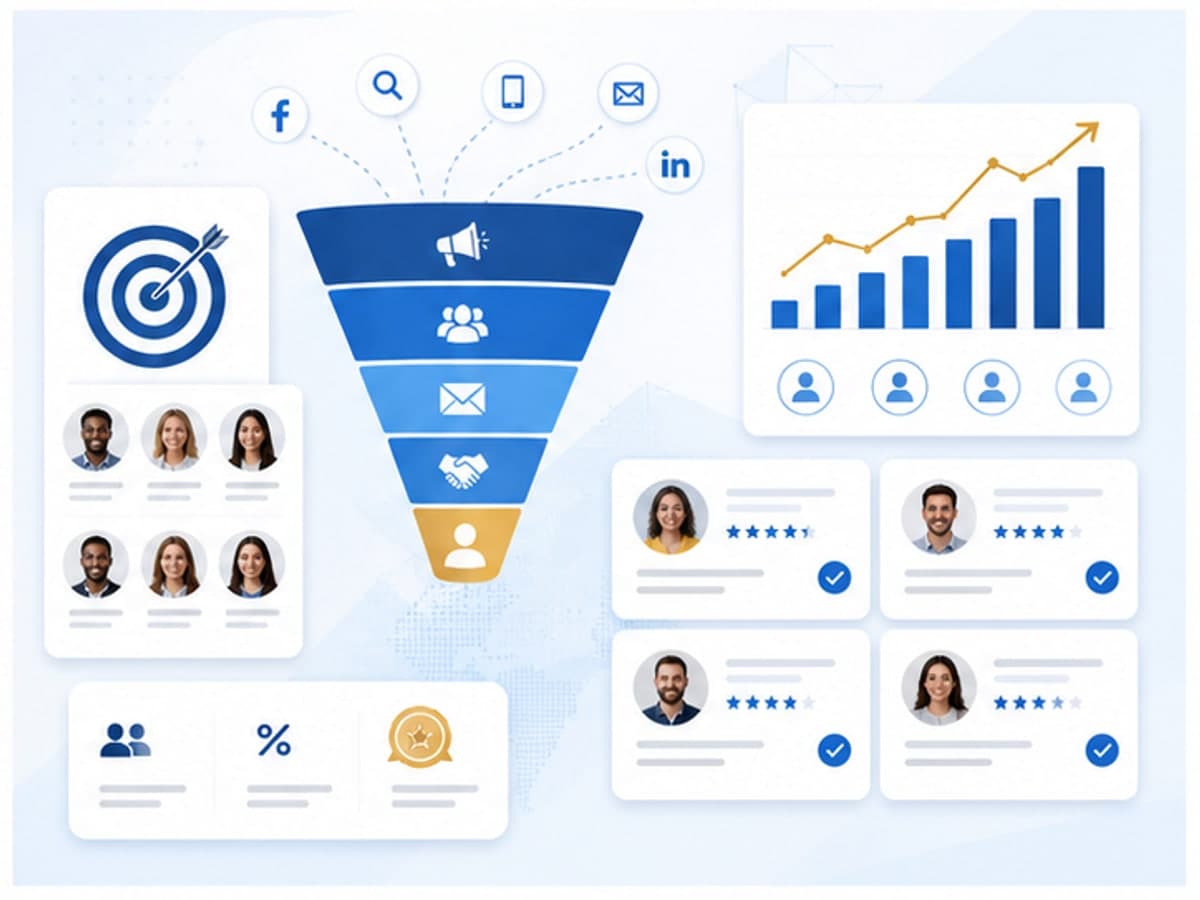
What inbound lead generation services actually do — capturing, qualifying, and converting the demand your marketing already creates — and why speed-to-lead is the highest-leverage fix in most funnels.
Inbound leads die of neglect, not competition
Most companies with an inbound problem do not have a demand problem — they have a response problem. Marketing generates form fills, calls, chats, and quote requests; then the leads wait. They wait for the next business day, for a rep between meetings, for a follow-up that happens once instead of five times. Meanwhile the prospect, still sitting at their keyboard with the problem fresh, fills out a competitor's form. Inbound lead generation services exist to close exactly that gap.
What an inbound lead generation team does
Immediate response, every channel
Calls answered live, form fills contacted within minutes, chats engaged in real time — during business hours and after them. Speed-to-lead is the single most powerful variable in inbound conversion: contact rates collapse as minutes pass, because interest is perishable in a way lead-scoring models never quite capture.
Qualification against your criteria
Every inquiry worked through your qualification framework — need, fit, authority, timeline — so sales receives opportunities, not raw form fills. The definition of "qualified" is written down and agreed before launch, exactly as we recommend in our outsourced lead generation guide.
Routing and scheduling
Qualified prospects are booked directly onto the right rep's calendar — by territory, product line, or deal size — with confirmations and reminders that protect show rates. Unqualified inquiries get a respectful answer and a tag, not silence.
Persistent, polite follow-up
Most inbound leads do not connect on the first attempt, and most teams stop after one or two tries. A disciplined cadence across phone and email — persistent without being obnoxious — is where outsourced teams beat stretched internal ones by the widest margin.
CRM hygiene and reporting
Every touch logged, every disposition recorded, every source tracked to opportunity — so marketing finally learns which campaigns produce pipeline rather than form fills.

Inbound vs outbound lead generation
Outbound creates demand: researching targets, cold outreach, building interest that did not exist. Inbound converts demand: responding to interest your marketing already paid for. They are different skills on different clocks — outbound rewards research and message iteration; inbound rewards speed, availability, and follow-up discipline. Mature programs run both, often with the same provider coordinating handoffs. For the outbound side, see our outsourced sales development guide.
When to outsource inbound response
- Leads arrive outside the hours your team works — evenings, weekends, other time zones.
- Marketing spend is growing but sales-accepted leads are not.
- Reps triage inquiries instead of closing — expensive people doing inexpensive work.
- Follow-up depends on individual habits rather than an enforced cadence.
- Speed-to-lead is measured in hours (or not measured at all).
Speed-to-lead is a distribution problem, not an effort problem
Every team that measures speed-to-lead discovers the same thing: the average is meaningless. Response time is not normally distributed. A team with a respectable-looking average is usually responding to weekday-morning leads in minutes and to Friday-evening leads on Monday, and the Monday leads are gone. Improving the average by working harder does nothing for the tail, because the tail is caused by nobody being there.
Look at your own response times plotted by hour of arrival and day of week rather than as a single figure. The shape tells you what to fix. If the distribution is tight and the average is poor, you have a process problem and a cadence will fix it. If the distribution has a long tail concentrated in evenings, weekends and holidays, no amount of internal discipline closes it — that is a coverage problem, and coverage is what an outsourced team sells.
The compounding effect nobody models
Speed does not only raise contact rate. It raises it at the moment of highest intent, which means the conversations you win by responding fast convert at a higher rate than the ones you win by responding late. The two effects multiply rather than add, which is why speed-to-lead improvements usually beat the forecast built from contact-rate assumptions alone.
It also compounds against your competitors. A prospect who submits three forms and is called back by one company in two minutes and the others the following day is rarely comparing three vendors. They are comparing one vendor to the memory of a form they filled out.
What to define before an outsourced team touches a lead
Inbound programs fail on specification far more often than on effort. Before launch, these need to be written down and agreed — not discussed, written:
- The qualification bar, stated as a test rather than an adjective. "Qualified" means nothing. "Has budget authority or direct access to it, a defined timeline within two quarters, and a use case in one of these four categories" means something a stranger can apply consistently.
- The disqualification rules. What a caller says that ends the conversation politely. Without these, an outsourced team optimises for volume of booked meetings and your reps' calendars fill with people who were never going to buy.
- The routing map. Territory, product line, deal size, language — and the fallback when the primary owner is unavailable, which is the rule that actually gets exercised.
- The cadence. How many attempts, over how many days, across which channels, at what times of day. Then the stopping rule, so leads are either worked or released rather than left in permanent limbo.
- The handoff artefact. Exactly what a rep receives with a booked meeting: qualification answers, context, source, and what was promised. A meeting handed over with no context is a meeting the rep runs cold.
- What must never be said. Pricing commitments, delivery dates, regulatory claims. Boundaries protect the brand and are far easier to enforce as a written list than as judgment.
The metrics that show whether it is working
Speed-to-lead is the input metric and the one to instrument first, but it is not the scoreboard. Judge the program on the chain:
- Contact rate — the share of inbound leads that reach a live conversation. The clearest measure of coverage and cadence discipline.
- Qualification rate — of contacted leads, the share meeting the written bar. A rate that climbs suspiciously fast usually means the bar is being loosened rather than the leads improving.
- Meeting-held rate — booked meetings that actually happen. This is where confirmation and reminder discipline shows up, and it separates a booking operation from a scheduling one.
- Sales-accepted rate — the share your reps agree were genuinely qualified. The single most important number in the chain, because it is the only one the outsourced team cannot influence unilaterally.
- Opportunity and won rate by source — which closes the loop back to marketing spend.
- Time-to-first-touch distribution — the percentiles, not the mean.
Review sales-accepted rate weekly for the first quarter. It is the metric where an outsourced team and an internal sales organisation are most likely to quietly disagree, and the disagreement is always about the definition rather than the effort.
Where inbound programs go wrong
- Paying per meeting booked. It is the most tempting commercial model and it reliably produces meetings that should not have been booked. Tie compensation to sales-accepted meetings or opportunities instead, so both sides are optimising for the same outcome.
- No feedback loop from reps. If reps mark a meeting unqualified and nothing happens, they stop marking. Within a quarter you have lost the only quality signal in the system.
- Treating every source identically. A pricing-page enquiry and an ebook download are different levels of intent and deserve different cadences. A single cadence applied to both over-works one and under-works the other.
- Ignoring the unqualified. A prospect who is a year early is not a bad lead; they are a lead with a date on it. Programs without a nurture path throw away a meaningful share of eventual pipeline.
- No CRM discipline. If dispositions are inconsistent, none of the metrics above can be computed, and the program becomes unmanageable precisely when it needs adjusting.
Integrating an outsourced team with your own sellers
The technical integration is straightforward and rarely the problem. The organisational one decides whether the program works, because you are inserting a group of people into the middle of a process your sales team already owns, and sellers reasonably read that as a judgment about their pipeline.
Three things reduce the friction more than anything else. Introduce the team as capacity rather than as oversight — they are handling the work that was going unhandled at eleven at night, not auditing anyone's follow-up. Give sellers a fast, low-effort way to reject a meeting with a reason, because a rejection path that takes four clicks and a written justification will not be used and you will lose the quality signal. And put the outsourced team and the sellers in the same room, physically or otherwise, at least monthly; programs where the two groups have never spoken generate disagreements that would evaporate in a ten-minute conversation.
Decide explicitly who owns the lead record at each stage, and when ownership transfers. Ambiguity here produces the two failure modes at once: leads worked twice by both teams, and leads worked by neither because each assumed the other had them.
Finally, make sure the outsourced team can see outcomes. A team that books meetings and never learns which became opportunities is optimising blind, and will drift toward whatever is easiest to book rather than what is worth booking.
The first ninety days
Inbound programs are judged too early and on the wrong number. A realistic shape: weeks one to three are calibration, where the team is contacting leads and the qualification bar is being argued about — expect sales-accepted rate to be poor and expect the argument, because it is how the written definition becomes a working one. Weeks four to eight are where contact rate and speed-to-lead should stabilise at target, and these are the metrics to hold the program to at this stage. Sales-accepted rate typically only becomes meaningful from week nine, once enough handoffs exist to judge and the feedback loop has run several cycles.
The most common mistake is cancelling in week five on a sales-accepted rate that was never going to be good yet, having ignored a contact rate that had already doubled. Agree in advance which metric governs which window, and the program gets judged on what it is actually doing.
Global Empire Corporation runs inbound lead generation programs — live response across phone, chat, and forms, qualification to your criteria, and booked meetings on your reps' calendars. Explore our inbound lead generation services and lead generation services, or request a proposal.
Frequently asked questions
What is inbound lead generation?
Capturing and converting demand that already exists — responding to inbound calls, form fills, and chats, qualifying each inquiry against defined criteria, and delivering sales-ready opportunities. Outbound creates interest; inbound converts it.
Why does speed-to-lead matter so much?
Because interest is perishable. A prospect contacted within minutes is still engaged with the problem; hours later they have moved on or contacted a competitor. Response time is the highest-leverage variable in inbound conversion.
What does an inbound lead generation service handle?
Live response across phone, web forms, and chat; qualification against your written criteria; appointment scheduling onto rep calendars; persistent multi-touch follow-up; and full CRM logging with source-to-opportunity reporting.
How is this different from an answering service?
An answering service takes messages. An inbound lead generation team runs qualification conversations, books meetings, executes follow-up cadences, and is measured on qualified opportunities delivered — not calls answered.
Can inbound and outbound lead generation be combined?
Yes, and they compound: the same provider can convert inbound demand while running outbound prospecting into your target market, with shared qualification standards and unified CRM reporting across both motions.
By service line
Keep reading
The rest of this cluster, for the question you are actually working through.
- Outsourced Lead Generation: How It Works and When It Pays Off
- Outsourced Sales Development: Building Pipeline Without Building a Team
- Telemarketing Outsourcing: A Buyer's Guide
- B2C Telemarketing: How Consumer Outbound Programs Actually Work
- Technical Support Outsourcing: A Complete Guide for 2026
- Outsourcing Live Chat Support: A Practical Guide
- Email Support Outsourcing: How to Scale Without Losing Quality
- Back Office Outsourcing: What to Transfer and What to Keep
- Multilingual Customer Support: Staffing It Properly, Not Translating It
- B2B Appointment Setting: Filling a Complex Pipeline Without Burning the Brand